
Rubber vs Vinyl ESD Workbench Mat: Which Material Performs Better on Benches?


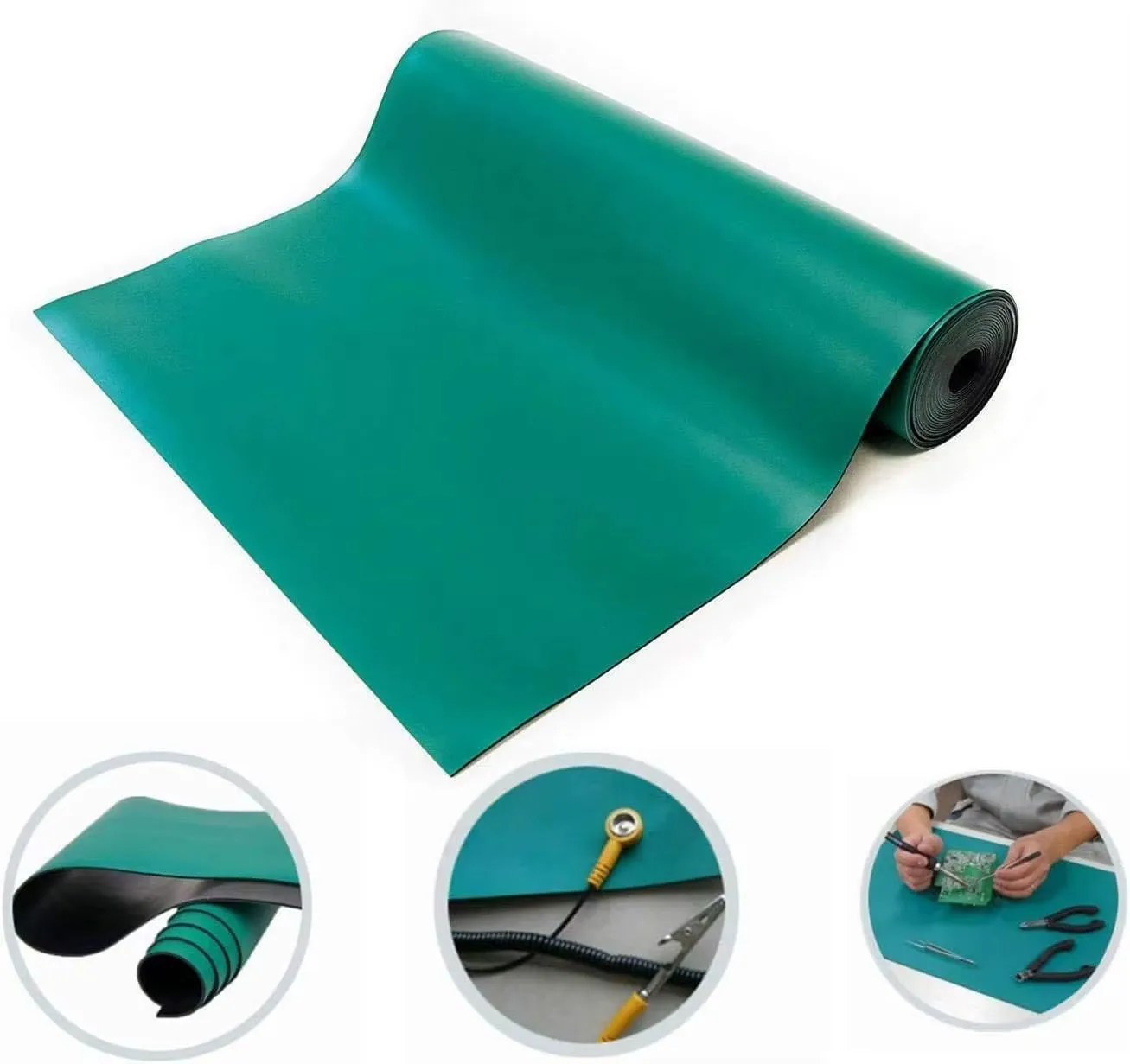
When you’re choosing an ESD workbench mat, “rubber vs vinyl” sounds like a simple materials question. In practice, it’s a process-control decision: you’re selecting a worksurface that must survive your bench reality (heat, abrasion, cleaners), while still providing a controlled path to ground that can be verified and maintained over time.
I’ll break this down the way I write RFQs and acceptance criteria: use case → material behavior → verification language → lifecycle cost.
Quick decision summary
If you need one rule that works most of the time
- Rubber performs better on soldering/rework benches because it has higher heat resistance and is commonly recommended for soldering applications.
- Vinyl performs better for fast deployment and cushioning needs because it’s typically easier to cut and is widely available in cushioned constructions that protect delicate parts.
- Neither material “performs better” if you can’t verify it. Worksurfaces are evaluated using resistance measurements (not just material names), and your ESD program should define acceptance and compliance checks.
Table 1 — Bench use case → best-fit material → why → what to specify
| Bench use case | Best-fit material | Why it typically performs better | What to specify |
|---|---|---|---|
| Soldering / rework / hot tools / occasional solder drops | Rubber | Higher heat tolerance; commonly preferred for soldering | “Rubber worksurface mat suitable for soldering benches; dissipative top + groundable construction; verify Rtg/Rtt per STM4.1/S4.1” |
| General assembly / inspection / QA benches | Vinyl (often) | Easier to cut/fit; cushioned variants reduce part damage | “Vinyl worksurface mat, cut-to-fit allowed; cushioning as needed; verify Rtg/Rtt per program” |
| Chemical cleaning is routine (aggressive wipes / frequent solvent exposure) | Rubber (often) | Rubber is commonly recommended where chemical resistance matters | “Chemical resistance requirement stated; rubber worksurface preferred; verify stability after cleaning” |
| Long bench runs / standardization across many stations | Vinyl or Rubber | Performance depends on construction + verification stability | “Batch consistency + traceability + verification plan (Rtg/Rtt) required” |
| Workstations with continuous monitoring requirement | Depends on construction | Compatibility varies; must be specified and confirmed | “Must be compatible with workstation continuous monitoring (as defined by facility program)” |
What “better performance” means on a workbench
On benches, I evaluate “performance” using four dimensions:
- Process durability (heat, abrasion, chemicals, cutting/curling risk)
- Controlled discharge path (worksurface behavior + ground path integrity)
- Verification stability (Rtg/Rtt stays in-range across time and cleaning cycles)
- Operational efficiency (install speed, standardization, ergonomics, replacement frequency)
The key point: material name is not a spec. ANSI/ESD STM4.1 frames worksurface evaluation as resistance measurement-based, using standard instruments to evaluate worksurface materials.
Rubber ESD workbench mats
Where rubber wins: heat and “hard bench” reality
If your bench sees soldering or hot tools, rubber is the default performance choice. Rubber has higher heat resistance than vinyl and is preferred for soldering applications.
Practical implications:
- Fewer surface failures from accidental heat contact
- More predictable lifecycle under rework conditions
- Less unplanned replacement downtime
Chemical and abrasion tolerance
Rubber is commonly recommended where heat and chemical resistance are required.
On benches with frequent wiping (especially with strong cleaners), rubber often maintains its “work surface” feel longer than thin vinyl constructions.
Typical rubber construction you’ll see (why it matters)
Most workbench rubber mats in professional catalogs are two-layer:
- Dissipative top (where parts and tools sit)
- Conductive bottom (supports grounding path)
This is frequently shown in selection charts and product documentation describing two-layer rubber worksurfaces.
Buyer takeaway: when you specify “rubber,” also specify construction (e.g., two-layer) and verification expectations—otherwise two suppliers may quote very different products that both claim to be “rubber ESD mats.”
Vinyl ESD workbench mats
Where vinyl wins: deployment speed and cut-to-fit benches
Vinyl is a strong choice when your priority is fast workstation rollout—especially if you’re cutting and fitting mats across many benches. Vinyl mats tend to be easier to cut.
This matters when:
- benches are non-standard sizes
- you’re doing a multi-line rollout
- you want minimal install friction
Cushioning and physical protection
Vinyl has an advantage in cushioned varieties, improving protection for delicate products and comfort for long-duration bench work.
If you handle fragile assemblies where small drops are common, cushioning can reduce damage that isn’t “ESD” but still hits yield.
Where vinyl is a poor fit
If your bench involves soldering or predictable heat exposure, vinyl often becomes the riskier choice. The industry guidance that rubber is preferred for soldering exists for a reason—vinyl can be damaged by heat contact.
Buyer takeaway: vinyl is not “worse,” it’s “fit-sensitive.” It performs well when the workstation is primarily assembly/inspection and the environment is controlled.
Performance comparison: rubber vs vinyl (bench-centric)
Table 2 — Material performance map (bench reality)
| Dimension | Rubber | Vinyl | Why it matters on benches |
|---|---|---|---|
| Heat / solder tolerance | Strong advantage | Lower tolerance | Soldering/rework benches need heat resilience |
| Chemical resistance (general) | Often better | Varies | Frequent cleaning can drift performance and surface integrity |
| Abrasion / tear | Often better | Varies | Tool drag and fixture friction drive lifecycle cost |
| Cut-to-fit / install speed | Moderate | Strong advantage | Faster deployment reduces labor and inconsistency |
| Cushioning options | Available (some constructions) | Common and flexible | Protects parts + improves operator comfort |
| Program verification | Must be verified | Must be verified | Both require Rtg/Rtt in-range and stable over time |
Verification and compliance language
The worksurface resistance range buyers reference
EOS/ESD Association fundamentals state that ESD protective worksurfaces with resistance to ground of 1.0 × 10⁶ to 1.0 × 10⁹ Ω provide equipotential behavior and a controlled path to ground.
Many supplier education resources echo this as a practical “worksurface requirement language” for Rtt/Rtg when aligning with ANSI/ESD S20.20 programs.
Why STM4.1 matters
STM4.1 emphasizes that the test method relies on resistance measurements to evaluate worksurface materials.
This is why I don’t accept “ESD safe” as a purchasing requirement. I require Rtg/Rtt language and a verification plan.
Important safety boundary (don’t over-claim)
STM4.1 also warns that a worksurface conductive enough to discharge an object may pose a safety hazard and that the presence of a worksurface tested per the method does not guarantee personnel safety.
Your content should state this clearly to avoid creating the wrong expectation.
Continuous monitoring compatibility: don’t let this become a retrofit problem
Some worksurface constructions are marketed as compatible with continuous monitors, while others are not recommended depending on the monitor strategy. In selection charts, you’ll see explicit “compatible/not recommended” notes tied to specific constructions.
How I handle this in sourcing:
- If the workstation requires continuous monitoring, I write it into the RFQ as a must-have requirement.
- I require the supplier to state compatibility in writing, aligned to our monitoring approach.
Procurement checklist
Table 3 — RFQ spec fields (make quotes comparable)
| Spec item | Must include | Nice to have | Receiving / acceptance check |
|---|---|---|---|
| Material | Rubber or vinyl | — | Matches PO |
| Construction | 2-layer / 3-layer; dissipative top + groundable path | Cushioning layer if needed | Matches datasheet |
| Bench use case | Soldering/rework vs assembly/inspection | Cleaning chemistry notes | Confirms correct fit |
| Electrical performance language | Rtg/Rtt requirement language aligned to program | Explicit STM4.1/S4.1 reference | Verify plan present |
| Monitoring | Must be compatible if required | Monitor model compatibility statement | Supplier confirmation |
| Format & sizing | Sheets vs rolls; cut-to-fit allowance | Color options | Dimensions match PO |
| Traceability | Lot/batch traceability | Certificate pack | Documents match shipment |
Common buyer mistakes (and how to avoid them)
Mistake 1: choosing by material only
“Rubber” and “vinyl” are categories, not specs. Always lock down construction + verification language.
Mistake 2: ignoring soldering reality
If there is hot solder or frequent heat exposure, rubber is commonly preferred. Skipping this results in premature surface failure and replacement churn.
Mistake 3: skipping monitoring requirements
If a line requires continuous monitoring, compatibility must be confirmed early; otherwise you retrofit after installation.
Mistake 4: no lifecycle governance
Worksurfaces drift due to cleaning residues, wear zones, and ground path issues. If you don’t define verification cadence and replacement triggers, your “ESD bench mat” becomes an ungoverned consumable.
Quick FAQs
Is rubber always better than vinyl for ESD benches?
No. Rubber typically wins when heat and harsher conditions dominate; vinyl often wins when cut-to-fit deployment and cushioning are priorities.
Which is better for soldering benches?
Rubber is commonly preferred because it has higher heat resistance than vinyl.
What resistance range should I request for a worksurface?
A commonly referenced range for ESD protective worksurfaces is 1×10⁶ to 1×10⁹ Ω resistance to ground, but your facility’s ESD control plan is the final authority.
Can I use rubber or vinyl mats with continuous monitors?
It depends on construction and monitor strategy. If monitoring is required, specify compatibility in the RFQ and request written confirmation.
How I recommend deciding
If you want a clean decision that procurement, engineering, and quality can all defend, use this sequence:
bench process reality (heat/chemicals/abrasion) → deployment needs (cut/cushion) → verification language (Rtg/Rtt) → monitoring requirement → RFQ + receiving checks
That’s how you buy a worksurface that performs not just on day one, but across the full lifecycle.
