
Plastic vs Metal Snow Shovel: Which One Is Better?
Neither plastic nor metal is always the best snow shovel material.
Plastic snow shovels are usually lighter, corrosion-resistant and less aggressive on sensitive surfaces. Steel blades provide stronger scraping and higher edge rigidity. Aluminum offers a lighter metal option, while a plastic blade with a metal wear edge provides a compromise between weight and scraping ability.
The right choice depends on:
- Snow depth and condition
- Working surface
- Clearing frequency
- Blade width and shape
- Handle design
- Working temperature
- Required scraping strength
For fresh snow and routine clearing, a reinforced plastic shovel is often practical. For packed snow or hard scraping, a metal edge or steel blade may perform better. Thick ice usually requires a dedicated ice scraper rather than a normal snow shovel.
Quick Decision: Plastic or Metal Snow Shovel?
| Main Condition | Better Starting Choice |
|---|---|
| Fresh, loose snow | Plastic shovel |
| Frequent clearing during snowfall | Lightweight reinforced plastic |
| Composite deck or coated floor | Full-plastic edge |
| General driveway with mixed snow | Reinforced plastic or aluminum |
| Wet, heavy snow | Strong blade with controlled width |
| Packed snow | Metal edge or steel blade |
| Thick ice | Dedicated ice scraper |
| Warehouse or facility entrance | Wide reinforced plastic shovel |
| Rough construction surface | Steel or heavy-duty metal edge |
| Distributor seasonal inventory | Multiple materials, widths and handle options |
This table is a starting point, not a universal rule.
Blade width, curvature, handle length, shovel weight and snow depth may be just as important as blade material.
Plastic, Aluminum and Steel Are Different
“Metal snow shovel” is a broad term.
A metal shovel may use:
- An aluminum blade
- A steel blade
- A plastic blade with a metal wear strip
These structures do not have the same weight, rigidity, corrosion resistance or scraping performance.
The most useful comparison is therefore not simply plastic versus metal. Buyers should compare the exact blade material and structure.
Plastic Snow Shovels
Plastic snow shovel blades are commonly made from PE, PP, composite plastic or another cold-weather formulation.
Their performance depends on the resin, blade thickness, reinforcement ribs and working temperature.
Main Advantages of Plastic Snow Shovels
Lower Tool Weight
Plastic blades are usually lighter than full-steel blades of a similar size.
A lighter shovel can reduce the total tool weight handled during repeated clearing. It may also be easier to carry, transport and store.
Safe lifting technique, snow load and working pace still matter.
Lower Scratching Risk
A full-plastic edge generally presents a lower scratching risk than an aggressive steel edge.
Plastic is often selected for:
- Composite decks
- Painted floors
- Epoxy-coated entrances
- Decorative paving
- Tile surfaces
- Warehouse floors
- Loading areas
However, a plastic blade is not completely scratch-proof.
Grit, stones, damaged edges and excessive force may still mark sensitive surfaces.
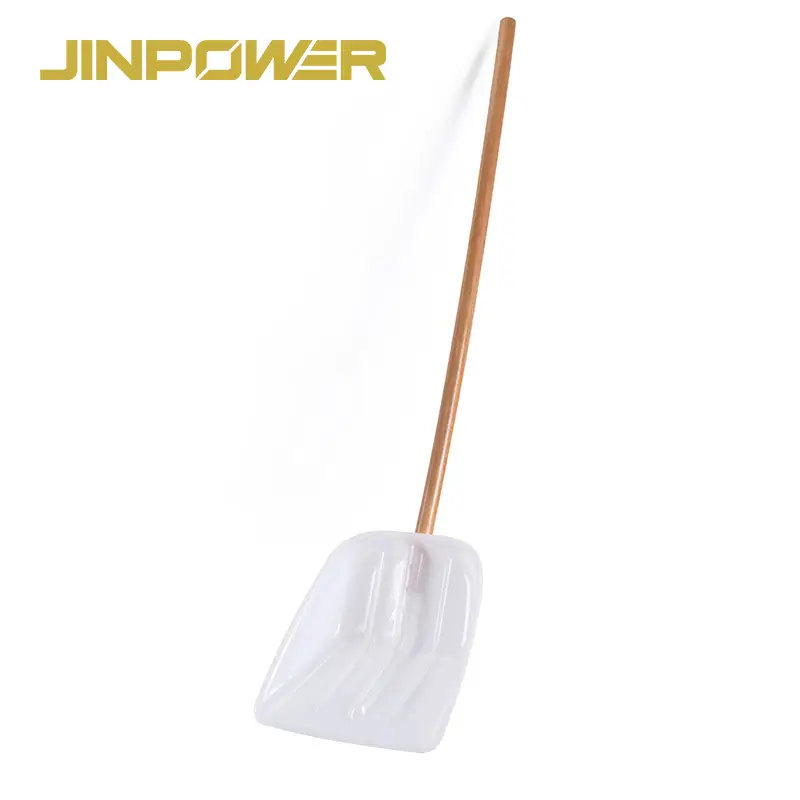
Corrosion Resistance
Plastic blades do not rust after exposure to snow, water and normal winter moisture.
This can be useful for outdoor storage, facility maintenance, vehicle kits and seasonal distributor stock.
The handle, screws and other metal parts may still require corrosion protection.
Molded Reinforcement
Plastic can be molded into a wide curved blade with:
- Reinforcement ribs
- Raised side walls
- Thickened stress areas
- Integrated handle sockets
- Smooth snow-release surfaces
- Full-plastic lower edges
A properly reinforced plastic blade can support routine commercial and facility snow clearing. Plastic should not be treated as a household-only material.
Main Limitations of Plastic Snow Shovels
Plastic may be less suitable for:
- Chopping thick ice
- Severe compacted snow
- Sharp gravel surfaces
- Aggressive scraping
- High-impact construction work
Cold-weather performance also varies by formulation.
A suitable plastic can retain useful toughness at its specified operating temperature. Low-quality or damaged plastic may become brittle in severe cold.
Buyers should confirm the material and working-temperature specification.
Aluminum Snow Shovels
Aluminum provides a middle option between plastic and steel.
It is generally lighter than steel while offering more edge rigidity than many plastic blades.
Main Advantages of Aluminum
- Lower weight than steel
- Better scraping ability than a full-plastic edge
- Good corrosion resistance
- Suitable for mixed snow conditions
- Easier handling than many heavy steel shovels
Main Limitations of Aluminum
- May bend under high load
- Can scratch sensitive surfaces
- Usually heavier than plastic
- Not always suitable for breaking thick ice
- Edge deformation can reduce scraping performance
Aluminum may be practical for general driveways, mixed snow and users who want a metal edge without the full weight of steel.
Steel Snow Shovels
Steel blades provide strong edge rigidity and aggressive scraping performance.
They are often selected for demanding surfaces and compacted snow.
Main Advantages of Steel
- Strong scraping edge
- High rigidity
- Good wear resistance
- Suitable for packed snow
- Better for rough concrete and demanding work areas
Main Limitations of Steel
- Usually heavier
- May increase operator effort
- Higher scratching risk
- Can rust if coatings are damaged
- Less suitable for delicate decks and coated floors
A steel shovel is not automatically better for every commercial application.
For frequent clearing of fresh snow across a large facility entrance, a wide lightweight plastic pusher may be more efficient than a heavy steel shovel.
What About a Plastic Shovel with a Metal Edge?
A plastic blade with a metal wear edge combines a lighter molded body with a more rigid scraping strip.
Possible Advantages
- Lower total weight than a full-steel shovel
- Better edge wear resistance than full plastic
- Improved scraping on packed snow
- Curved plastic blade can still support wide pushing
Possible Limitations
- Higher scratching risk on sensitive surfaces
- Metal strip may loosen or deform
- Metal edge can corrode
- Still not a replacement for an ice-breaking tool
This structure can be useful for mixed surfaces, but buyers should confirm how the metal strip is attached and whether replacement parts are available.
Plastic vs Aluminum vs Steel Comparison
| Comparison Factor | Plastic Blade | Aluminum Blade | Steel Blade |
|---|---|---|---|
| Tool weight | Usually lowest | Medium | Usually highest |
| Fresh snow | Very suitable | Suitable | Suitable |
| Wet snow | Depends on width and reinforcement | Suitable | Suitable but heavier |
| Packed snow | Limited without metal edge | Moderate | Strong |
| Ice scraping | Not recommended for aggressive use | Limited to moderate | Strongest |
| Sensitive surfaces | Lower scratching risk | Moderate risk | Higher risk |
| Corrosion | Does not rust | Corrosion-resistant but may oxidize | Needs coating and care |
| Flexibility | Can flex | May bend | More rigid |
| Operator effort | Usually lower | Medium | Usually higher |
| Typical use | Routine clearing and sensitive surfaces | General mixed use | Hard scraping and rough surfaces |
Which Shovel Is Better for Fresh Snow?
Plastic is usually the better starting choice for fresh, loose snow.
Its lower weight supports:
- Frequent clearing
- Wide-area pushing
- Walkway maintenance
- Facility entrance clearing
- Residential driveways
- Vehicle emergency use
A wide reinforced plastic blade can move more snow per pass, but an excessively wide blade may become difficult to control when the snow is wet or deep.
Which Shovel Is Better for Wet, Heavy Snow?
There is no answer based only on blade material.
For wet snow, buyers should also consider:
- Blade width
- Scoop depth
- Blade curvature
- Total shovel weight
- Handle length
- Whether the snow will be pushed or lifted
A wide heavy shovel may carry too much snow.
A narrower reinforced blade may be easier to control, even if it is made of plastic.
Which Shovel Is Better for Packed Snow?
Packed snow usually requires greater edge rigidity.
Suitable options may include:
- Steel shovel
- Aluminum shovel
- Plastic shovel with a metal wear edge
- Separate snow scraper
A full-plastic edge is generally not the best choice for aggressive scraping of frozen packed snow.
Which Shovel Is Better for Decks and Sensitive Surfaces?
A full-plastic edge is usually the safer starting choice for:
- Composite decks
- Wood decks
- Coated concrete
- Decorative paving
- Painted floors
- Epoxy surfaces
Before clearing, remove grit and stones where practical.
Inspect the blade edge for sharp damage that could mark the surface.
Which Shovel Is Better for Facilities and Commercial Sites?
Commercial use does not automatically require a metal shovel.
The choice should follow the task.
| Commercial Task | Selection Direction |
|---|---|
| Frequent clearing during snowfall | Reinforced plastic shovel |
| Wide warehouse entrance | Wide plastic snow pusher |
| Coated loading area | Full-plastic edge |
| Rough concrete with packed snow | Steel or metal-edge shovel |
| Mixed facility surfaces | Several tool types |
| Emergency vehicle kit | Lightweight plastic or aluminum |
| Ice removal | Dedicated ice scraper |
| Maintenance fleet | Standardized replaceable blades and handles |
Many facilities benefit from using more than one snow-removal tool.
A plastic pusher can handle fresh snow, while a metal scraper can be reserved for packed areas and ice.
Blade Design Can Matter More Than Material
Material alone does not determine performance.
| Design Feature | Why It Matters |
|---|---|
| Blade width | Affects clearing speed and snow load |
| Blade height | Affects how much snow can be pushed |
| Blade curvature | Influences snow movement and release |
| Blade thickness | Affects rigidity and wear |
| Reinforcement ribs | Help distribute pushing force |
| Edge structure | Controls scraping and surface contact |
| Handle socket | Common stress point during repeated use |
| Handle length | Affects posture and control |
| Total weight | Affects repeated-use effort |
| Working temperature | Affects material performance |
A poorly designed steel shovel may be less useful than a well-reinforced plastic shovel for routine snow pushing.
Common Selection Mistakes
| Mistake | Why It Creates Problems |
|---|---|
| Assuming plastic is only for residential use | Reinforced plastic is also suitable for facilities and commercial maintenance |
| Assuming metal is always stronger | Aluminum can bend, and design quality still matters |
| Choosing only by blade width | A wider shovel increases snow load |
| Ignoring the working surface | Metal edges may damage sensitive surfaces |
| Using a snow shovel to break thick ice | A dedicated ice tool is safer for the equipment |
| Ignoring cold-temperature performance | Material behavior changes at low temperatures |
| Checking the blade but not the handle joint | Many failures occur at the connection |
| Buying one tool for every condition | Mixed sites often need several tool types |
What Buyers Should Compare Before Ordering
Distributors, importers and facility buyers should request a complete specification.
| Check Item | What to Confirm |
|---|---|
| Blade material | PE, composite PE, PP, aluminum or steel |
| Material grade | Confirmed formulation or metal type |
| Working temperature | Lowest expected use and storage temperature |
| Blade thickness | Nominal or minimum thickness |
| Reinforcement | Ribs and thickened stress areas |
| Blade dimensions | Width, height and depth |
| Edge design | Full plastic, metal strip or full metal |
| Handle material | Wood, steel, aluminum, fiberglass or plastic |
| Handle length | Working comfort and shipping size |
| Handle connection | Fasteners and replacement method |
| Total tool weight | Important for repeated use |
| Intended snow type | Fresh, wet, packed or mixed |
| Intended surface | Deck, concrete, coated floor or rough pavement |
| Supply format | Complete shovel or shovel head only |
| Replacement parts | Blade, handle and fastener availability |
| OEM options | Color, logo, label and packaging |
| Documents | Specification, dimensions and packing information |
JINPOWER Composite PE Plastic Snow Shovel Support
For buyers who prioritize lower weight, corrosion resistance, wide-area pushing and lower surface-damage risk, JINPOWER supplies reinforced composite PE plastic snow shovels.
Available product discussions can include:
| Support Item | Available Options |
|---|---|
| Blade material | Reinforced composite PE |
| Standard blade sizes | 370 × 400mm and 470 × 400mm |
| Blade structure | Thickened blade with reinforcement ribs |
| Edge design | Full-plastic edge |
| Supply format | Complete shovel or shovel head only |
| Color | Standard or customized |
| Branding | Logo, label and private packaging |
| Order type | Distributor, facility or seasonal bulk order |
| Documents | Product specification and packing information |
A full-plastic edge is especially suitable for buyers who need routine snow clearing on sensitive or coated surfaces.
For more material background, read why snow shovels are made of plastic.
For a broader overview, review our snow shovel types and materials guide.
RFQ Checklist for Snow Shovels
| RFQ Information | What to Provide |
|---|---|
| Target market | Distributor, retailer, facility or project |
| Snow condition | Fresh, wet, packed or mixed |
| Surface | Concrete, deck, coated floor or rough pavement |
| Blade material | Plastic, aluminum, steel or mixed edge |
| Blade size | Required width, height and depth |
| Handle | Material, length and grip requirement |
| Supply format | Complete shovel or shovel head |
| Quantity | Trial, seasonal or annual demand |
| Color | Standard or customized |
| Branding | Logo, label and packaging |
| Packing | Carton quantity, pallet and shipping requirements |
| Documents | Specification and packing details |
Clear application information helps avoid choosing a blade only by price or appearance.
FAQ About Plastic and Metal Snow Shovels
Is plastic or metal better for fresh snow?
Plastic is usually lighter and well suited to frequent clearing of fresh snow.
Blade width and shape still affect performance.
Which shovel is better for wet, heavy snow?
A strong blade with a controlled width is usually easier to handle.
The best choice depends on blade shape, tool weight and whether the snow will be pushed or lifted.
Can a metal snow shovel damage a deck?
Yes. A metal edge generally presents a higher scratching risk on wood, composite decking and coated surfaces.
A full-plastic edge is usually a better starting choice.
Do plastic snow shovels break in extreme cold?
Performance depends on the plastic formulation, blade thickness, existing damage, aging and actual temperature.
Buyers should confirm the specified working-temperature range.
Is aluminum better than steel?
Aluminum is usually lighter and more corrosion-resistant.
Steel generally provides greater edge rigidity and stronger scraping performance.
Is a plastic shovel with a metal edge a good compromise?
It can provide a lighter blade with improved edge wear and scraping ability.
However, the metal edge increases scratching risk and does not replace a dedicated ice scraper.
Are plastic snow shovels suitable for commercial use?
Yes.
Reinforced plastic snow shovels are suitable for many facility entrances, warehouses, loading areas and property maintenance tasks.
Commercial suitability depends on blade structure and the intended snow condition.
What should distributors check before ordering?
Check the exact material, working temperature, blade size, thickness, reinforcement, handle connection, supply format, packaging, OEM options and replacement-part availability.
Final Guidance
Choose a plastic snow shovel when your priorities are:
- Lower tool weight
- Frequent clearing
- Corrosion resistance
- Sensitive-surface contact
- Wide-area snow pushing
- OEM color and packaging flexibility
Choose aluminum when you need:
- A lighter metal blade
- Moderate scraping performance
- Mixed snow use
- Better corrosion resistance than ordinary steel
Choose steel when you need:
- High edge rigidity
- Strong scraping
- Packed-snow removal
- Rough-surface work
Choose a plastic blade with a metal edge when you need a balance between lower weight and stronger scraping.
For thick ice, use a dedicated ice scraper rather than relying on an ordinary snow shovel.
The best snow shovel is not determined by material alone. Blade width, curvature, thickness, reinforcement, handle design, temperature and working surface must also be considered.
Sourcing Plastic Snow Shovels for Seasonal or Facility Use?
Tell us your required blade size, snow condition, working surface, handle configuration, color, quantity, packaging and OEM needs.
JINPOWER supplies reinforced composite PE plastic snow shovel heads for distributors, facility maintenance teams and seasonal bulk procurement.
