
Recommended News
Hot News
Fill in your information
Fiberglass Extension Ladders (FRP) — Built for Electrical Work, Ready for Everyday Jobs
Non-conductive FRP construction covers substations, switchgear rooms, and plant bays. The line ships in 2-section and 3-section / triple formats, plus A-frame extension variants. Heavy-duty and lightweight profiles align with on-site staging or high-frequency carry. An ≤150 kg industrial rating, smooth lift system, anti-slip feet, and corrosion-resistant hardware form a stable work platform. Color options include a black fiberglass extension ladder finish; branding and labeling support OEM.
Compliance and delivery are built in. Every order includes a GB/T 17620-2008 test summary, COC, multi-language safety labels, inspection/maintenance guidance, serialized QR asset IDs, export-grade packing, and on-time shipment. One team owns spec lock, accessory selection, technical support, and after-sales—end to end. For any fiberglass extension ladder scenario, provide height, sections, weight class, and accessories; we handle the rest.


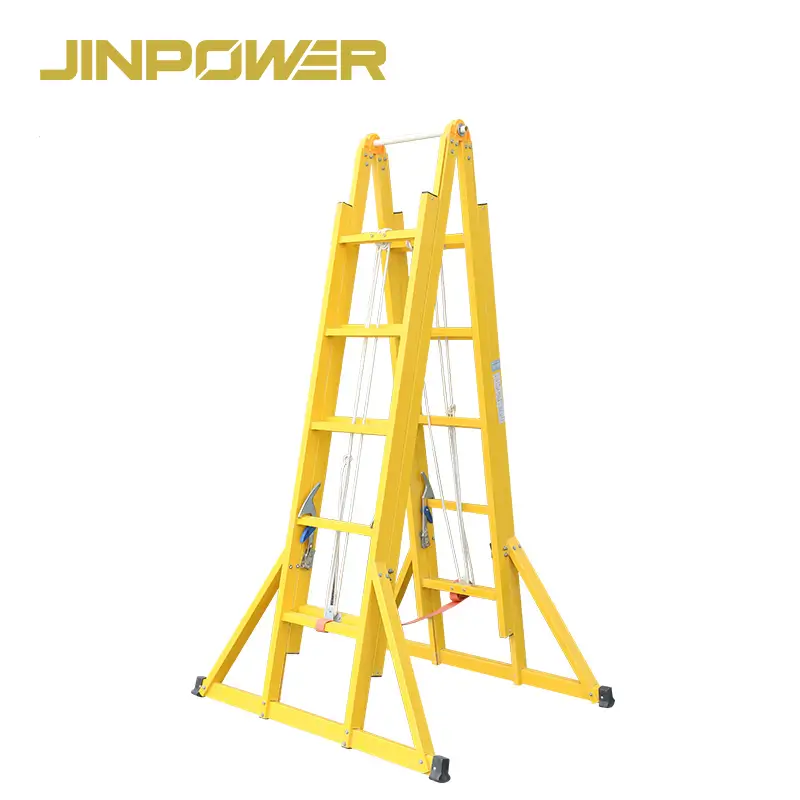
Fiberglass Extension Ladder Types (FRP)
| Field | Fiberglass Extension Single Ladder | Heavy-Duty Fiberglass A-Frame Extension | Fiberglass Extension Hanging Ladder (Hooked Top) |
|---|---|---|---|
| Model | JN-SJDT | JN-SIHT | JN-SIDTG |
| Working Height | 3–12 m | 3–12 m | 3–12 m |
| Rated Load | ≤150 kg | ≤150 kg | ≤150 kg |
| Rails / Material | Alkali-free FRP (fiberglass), ~3 mm wall; non-conductive, corrosion-resistant | Alkali-free FRP, ~3 mm wall; non-conductive | Alkali-free FRP, ~3 mm wall; non-conductive |
| Form / Use | Straight extension ladder for lean tasks in corridors and bays | A-frame start (panel work) + convert to straight/extension; one ladder, two postures | Top-hook hanging design for secure hang-off on beams/racking where floor space is limited |
| Feet / Contact | Anti-slip rubber feet; wide/swivel optional | Anti-slip feet; optional widened top/platform for dwell comfort | Anti-slip feet (floor-safe) |
| Key Hardware | Rope-and-pulley optional; standoffs/wall pads for stable leans | Heavy-duty rail section; rope-and-pulley; platform/tool tray options | Integrated hooked top; rope-and-pulley optional |
| Best For | Substations, switchgear corridors, cable-tray runs (fast deployment) | Control rooms/panel fronts → upper bay service (minimal ladder swaps) | Hang-off access where staging space is tight; quick positioning along lineups |
| Branding & Docs | OEM branding, serialized QR/barcodes; GB/T 17620-2008 summary + COC | OEM branding, serialized QR/barcodes; GB/T 17620-2008 summary + COC | OEM branding, serialized QR/barcodes; GB/T 17620-2008 summary + COC |
Power-Industry Application — How Fiberglass Extension Ladders Serves Substations & Switchgear
Designed for live-adjacent environments. The Fiberglass Extension Ladders alkali-free FRP rails (~3 mm wall) are non-conductive and corrosion-resistant, giving crews a stable access platform for substations, switchgear rooms, MCC corridors, bus ducts, and cable-tray runs. The spec translates cleanly into power-industry workflows:
Electrical safety & compliance
- Non-conductive FRP rails establish a safer access envelope around energized infrastructure and live-adjacent routes.
- Shipment includes GB/T 17620-2008 test summary and COC, plus multi-language labels and user/maintenance guidance—streamlined for utility audits and contractor onboarding.
Access geometry that fits the room
- Extension (working) height 3–12 m covers common bay elevations, tray crossings, and outdoor equipment lines.
- A-frame (combination) height 1.5–6.6 m positions techs at panel height for inspection, relay cabinet work, and front-of-gear tasks—then converts to straight reach for upper runs. One ladder, continuous workflow.
Load, stiffness, and stability for tools in hand
- ≤150 kg industrial rating supports technician + PPE + tool loadouts typical in utility maintenance.
- ~3 mm FRP wall thickness increases rail stiffness versus commodity builds, reducing perceived sway at inspection heights.
Reliable lift system for repetitive cycles
- Chrome-plated catches improve hardness and wear life under daily raise/lower routines and truck mounting.
- Nylon pulleys (high bend/impact strength) and nylon insulated rope (high-tenacity filaments) deliver smooth, predictable hoist action—useful for frequent repositioning across bays.
Floor and asset protection
- Anti-slip rubber feet protect coated concrete and epoxy floors found in switchgear rooms; optional wide/swivel feet increase contact on rougher outdoor pads.
Corrosion and weather resilience
- Alkali-free FRP resists salts, moisture, and industrial atmospheres, supporting coastal substations and plant-adjacent outdoor work without the pitting and staining typical of bare metal ladders.
Traceability & fleet control
- Serialized QR/barcodes tie units to inspection logs and asset registers; labels are audit-friendly for utility compliance programs.
Project fit & OEM
- Spec-lock at quote: height/sections, feet type, rope-and-pulley, standoffs, wall pads, tool trays, color (incl. Black), branding. Export packing with moisture protection and palletization keeps multi-site deployments clean and repeatable.
Outcome for utilities: one ladder that covers panel-height starts + upper-bay reach, maintains a non-conductive boundary, passes documentation checks, and holds up to daily plant realities.
Safety & Compliance — Electrical Use, Documentation, and Boundaries
Fiberglass Extension Ladders operates as a non-conductive access ladder for live-adjacent electrical work. Use it where aluminum is restricted; follow labels and local regulations.
Scope & standards
- Electrical scope: substations, switchgear rooms, MCC corridors, bus ducts, cable-tray routes.
- Documentation shipped: GB/T 17620-2008 test summary (insulating rigid ladders), COC, multi-language safety labels, user & maintenance guide.
- Labeling: hazard pictograms, load rating (≤150 kg), inspection cadence, and retirement conditions are printed and durable.
Usage boundaries
- Keep rails clean and dry; contamination reduces surface insulation.
- Do not use near energized parts with conductive contamination present (wet cement slurry, metal dust). Clean before re-entry.
- Do not exceed the printed duty rating; avoid side-loading beyond the manufacturer’s stance envelope.
- Retire units showing cracks, fiber bloom, deep gouges, heat damage, bent hardware, or illegible labels.
Inspection & care
- Pre-use check: rails, rungs, catches, pulleys, rope, and anti-slip feet.
- Periodic check: verify 3 mm alkali-free FRP rails are free of UV chalking or delamination; confirm catches and fasteners hold; replace worn feet.
- Cleaning: mild detergent and water; avoid aggressive solvents that soften resin.
- Storage/transport: rack by the rails, not rungs; shield from chemical splash and prolonged sunbake; strap securely in vehicles.
Policy alignment
- Treat Fiberglass Extension Ladders as the default ladder in electrical areas.
- Keep aluminum ladders out of rooms with energized equipment unless policy explicitly allows and all hazards are controlled.
- Integrate serialized QR/barcodes into asset logs and inspection records to satisfy audit trails.
Crews maintain a non-conductive boundary, pass paperwork checks, and keep the ladder inside its rating window through routine care.
Use Cases & Selection Matrix — Pick the Setup that Fits the Bay, the Route, and the Van
Fiberglass Extension Ladders covers panel-height starts and upper-bay reach in one ladder. Choose 2-section for stiffness and speed, 3-section (triple) for shorter closed length in tight routes, A-frame + extension when the job starts at the panel and finishes overhead.
- Substations & switchgear rooms: live-adjacent tasks, inspection, relay cabinets, front-of-gear work → A-frame 1.5–6.6 m, then extend to the target height.
- Plant bays & cable-tray corridors: overhead crossings and service points → Extension 3–12 m, add standoffs/wall pads for stable lean.
- MCC corridors & bus ducts: frequent micro-moves along a line-up → Lightweight profile for carry speed, nylon pulley + insulated rope for smooth hoist.
- Coastal/chemical sites: corrosion exposure → alkali-free FRP rails (~3 mm wall) and chrome catches resist salts and industrial atmospheres.
- Stairwells/elevators & tight van racks: routing constraints → 3-section (fiberglass triple extension ladder) for shorter closed length.
| Scenario | Electrical Risk | Route Constraint | Recommended Height Mode | Sections | Weight Class | Key Options |
|---|---|---|---|---|---|---|
| Switchgear room panel work → overhead inspection | Live-adjacent | Normal | Start A-frame 1.5–6.6 m, extend upward | 2–3 | Heavy-duty | Tool tray, wall pads, platform top |
| Substation bay overhead service | Live-adjacent | Normal | Extension 3–12 m | 2 | Heavy-duty | Standoffs, rope & pulley |
| MCC lineup, many short moves | Live-adjacent | Tight aisles | Extension 3–9 m | 3 | Lightweight | Rope & pulley, compact closed length |
| Cable-tray corridor with frequent repositioning | Live-adjacent | Long corridor | Extension 4–10 m | 2 | Lightweight | Rope & pulley, wide feet |
| Outdoor pad near electrical equipment | Possible | Uneven pads | Extension 4–12 m | 2 | Heavy-duty | Swivel/wide feet, standoffs |
| Coastal or chemical atmosphere | Low–Med | Normal | Extension 3–12 m | 2–3 | Heavy-duty | Black finish (low-glare), stainless fasteners (project-specific) |
- Pick height mode first (A-frame start vs straight extension), then sections (2 for stiffness/speed, 3 for shorter closed length).
- Align weight class to carry profile: lightweight for frequent moves, heavy-duty for long dwell and rough pads.
- Add standoffs/wall pads for stable lean and clearance; use wide/swivel feet on textured or sloped surfaces.
Fiberglass Extension Ladders, Engineered for Utility Crews
Structure that feels planted. Side rails use alkali-free FRP with an approx. 3 mm wall, delivering high stiffness and corrosion resistance in substation air, coastal spray, and industrial atmospheres. Crews stand on rungs that resist torsion, so the ladder feels steady at panel height and during overhead reach.
Extension system built for repetition. Chrome-plated catches add surface hardness and wear life under daily raise/lower cycles and truck rack handling. Nylon pulleys bring high bend/impact strength; the nylon (polyamide) insulated rope combines tensile capacity with fatigue resistance for predictable hoist action across long corridors.
Height envelope that matches the work. A-frame (combination) height 1.5–6.6 m positions technicians at front-of-gear without overreaching; the extension height 3–12 m covers bay service points, cable-tray crossings, and outdoor equipment pads. One ladder moves from panel checks to upper-bay tasks without a tool change.
Industrial rating with real payload. The ladder supports ≤150 kg—room for the technician, PPE, and the tool set that actually leaves the truck. Anti-slip rubber feet protect epoxy floors and grab outdoor pads; wide or swivel feet are available for texture or slope.
Documentation and audits handled. Each unit ships with a GB/T 17620-2008 test summary (insulating rigid ladders), COC, multi-language labels, and a concise user/maintenance guide. Serialized QR/barcodes tie the ladder to inspection logs, spares, and site assets.
Why crews keep it on the van. The Fiberglass Extension Ladders condenses what utilities ask for—non-conductive boundary, dependable extension hardware, corrosion-steady rails, and paperwork that clears procurement—into one repeatable specification.
Customization & OEM — Spec It Your Way, Then Scale It
We lock your specification—height/sections, weight class, feet, accessories, finish, branding—and deliver a repeatable build for fleets and projects.
Configuration options
- Height & sections: extension 3–12 m; A-frame 1.5–6.6 m; 2-section or 3-section (triple) for shorter closed length.
- Weight class: lightweight for high-frequency carry; heavy-duty for long dwell and rough pads.
- Feet & contact: anti-slip rubber standard; wide or swivel feet for textured/slope surfaces; wall pads and standoffs for lean stability.
- Lift kit: rope-and-pulley with nylon pulleys + nylon (polyamide) insulated rope; replacement kits for spares management.
- Top & tools: platform/top cap options, tool tray and small parts holders for panel-height tasks.
- Finish & visibility: safety yellow standard; black fiberglass extension ladder finish available; reflective decals on request.
- Branding & IDs: OEM logo/graphics, multi-language labels, serialized QR/barcodes tied to your asset system.
- Documentation pack: GB/T 17620-2008 test summary + COC; optional project-named PDFs, inspection checklists, and maintenance cards.
Logistics & packaging
- Export cartons with moisture barriers; palletized for bulk.
- Kitting by site or crew (ladder + feet option + standoff + rope kit) to simplify field deployment.
- Lead-time windows agreed at spec-lock; replenishment schedules available for utilities and EPCs.
Private label & fleet control
- Consistent rail/resin stack-up and ~3 mm wall spec retained across batches.
- Color-way and label schema fixed per customer; change control through revision IDs.
Service Promise — Quality, Lead Time, After-Sales
We deliver a spec-locked fiberglass extension ladder with predictable quality and on-time shipment—then stay available for parts and support.
Quality control
- Three-stage QC: incoming materials → in-process checks → final inspection; batch retains for traceability.
- Consistent rail/resin stack-up and ~3 mm FRP wall per spec; duty rating ≤150 kg verified.
- Labeling, QR/barcodes, and documentation (GB/T 17620-2008 summary + COC) verified before packing.
Lead time & logistics
- Lead-time window confirmed at spec-lock; expedited slots available when capacity allows.
- Export cartons with moisture protection; palletization for bulk; site/crew kitting on request.
- Proactive shipping updates with packing list, HS codes, and weight/volume data.
After-sales
- Technical guidance for installation, pre-use inspection, and maintenance.
- Spare kits (feet, rope-and-pulley, labels) stocked to match your fleet.
- Issue response within the agreed SLA; root-cause report if needed.
FAQ
Get a Spec-Locked Quote
Share the essentials and receive a spec-locked configuration with lead-time window today:
- Height & sections: A-frame 1.5–6.6 m, extension 3–12 m, 2-section or 3-section
- Weight class: Heavy-duty or lightweight
- Feet & contact: anti-slip standard; wide/swivel, standoffs, wall pads
- Lift & top: rope-and-pulley kit, platform/top, tool tray
- Finish & branding: safety yellow or black, OEM labels, serialized QR/barcodes
- Quantity & destination: packing, palletization, and shipping terms provided with the quote
We confirm documentation (GB/T 17620-2008 summary, COC), labeling, and packing in the same response—ready for procurement.



 Hrvatski
 Čeština
 Dansk
Dansk Nederlands
 Filipino
 Français
 Deutsch
 Italiano
 日本語
日本語 Қазақ тілі
 ភាសាខ្មែរ
 한국어
한국어 Кыргызча
 ພາສາລາວ
 Монгол
 فارسی
فارسی Polski
 Português
 Română
 Русский
 Slovenščina
 Español
 Kiswahili
 ไทย
ไทย Українська
 Tiếng Việt
 English