
What Is an Insulated Rescue Hook?
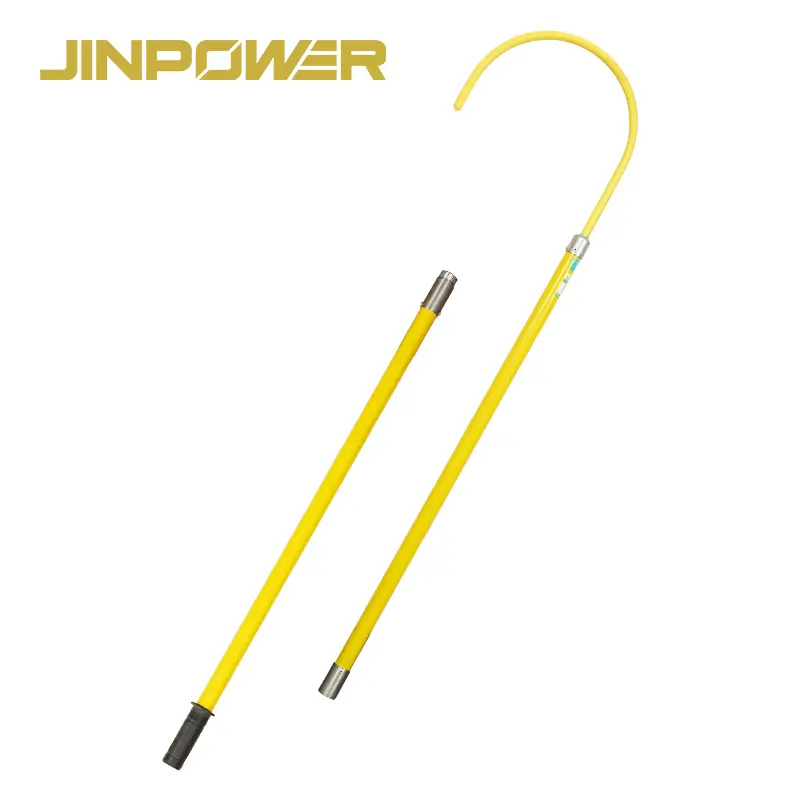
An insulated rescue hook is an emergency electrical safety tool with an insulating shaft and a curved hook. It is designed to help trained responders separate a person from an electrical contact hazard without using their hands directly.
It is commonly installed in substations, switchgear rooms, motor control centers, high-voltage testing laboratories, transformer rooms and other electrical facilities.
An insulated rescue hook is not a normal switching tool. It does not replace de-energization, lockout/tagout, voltage verification, electrical PPE, first aid or emergency medical support.
De-energization is the primary control. The rescue hook should only be used as part of an approved site emergency response procedure.
Quick Answer: What Is an Insulated Rescue Hook Used For?
| Question | Answer |
|---|---|
| What is it? | An insulated pole with a curved hook for electrical emergency response |
| What is its purpose? | To help trained responders create separation without direct hand contact |
| Where is it used? | Substations, switchgear rooms, test laboratories and industrial electrical areas |
| Does it replace de-energization? | No |
| Does it replace electrical PPE? | No |
| Does it provide arc-flash protection? | No |
| Can it be used for lifting? | No |
| Who should use it? | Trained personnel following an approved emergency procedure |
How Does an Insulated Rescue Hook Help?
During an electrical incident, directly touching an affected person may expose the responder to the same electrical hazard.
An insulated rescue hook helps the responder maintain additional distance while attempting emergency separation under the site rescue procedure.
Its basic design usually includes:
- An FRP or specified insulating shaft
- A smooth, curved rescue hook
- A high-visibility shaft or hook
- Product identification and warning labels
- A wall bracket or quick-access mounting holder
- Fixed, sectional or project-specific length options
The tool should be stored where trained responders can reach it quickly without first crossing the electrical hazard area.
When May an Insulated Rescue Hook Be Used?
An insulated rescue hook may be included in an electrical emergency response plan for areas such as:
- Switchgear rooms
- Substations
- Motor control centers
- Transformer rooms
- High-voltage testing laboratories
- Electrical maintenance workshops
- UPS and battery rooms
- Industrial control rooms
- Power distribution facilities
Its purpose is limited to emergency separation under an approved rescue procedure.
The electrical condition, access route, available PPE, responder training and emergency plan must all be considered before use.
What an Insulated Rescue Hook Can and Cannot Do
| Appropriate Purpose | Not an Appropriate Purpose |
|---|---|
| Support emergency separation under an approved rescue procedure | Replace de-energization |
| Help maintain additional distance from direct contact | Replace lockout/tagout |
| Reduce the need for direct hand contact | Replace voltage verification |
| Support trained electrical emergency response | Provide arc-flash protection |
| Remain ready at a clearly marked emergency location | Perform routine switching |
| Support site rescue drills and emergency planning | Move cables or conductors |
| Be used with required PPE and medical response planning | Lift or transport a person |
An insulated rescue hook should not be treated as a general-purpose hot stick.
It should not be used for routine conductor handling, fuse operation or switching unless a separate tool is specifically designed, rated and approved for that task.
Does an Insulated Rescue Hook Replace De-Energization?
No.
The preferred safety action is to isolate and de-energize the electrical source according to the approved procedure.
An insulated rescue hook is an emergency support tool. It is not a substitute for:
- Power isolation
- Lockout/tagout
- Voltage verification
- Temporary grounding
- Electrical insulating PPE
- Arc-rated PPE
- First aid
- CPR training
- Emergency medical services
Electrical equipment that has not been correctly verified as de-energized should continue to be treated according to the applicable site electrical safety procedure.
Follow local regulations and your site safety procedure.
Does an Insulated Rescue Hook Protect Against Arc Flash?
No.
An insulated rescue hook is not arc-rated PPE and does not make it safe to enter an active arc-flash or electrical fault area.
Responders should not enter an uncontrolled hazard zone unless the electrical condition has been controlled and the approved emergency procedure permits entry.
The rescue plan should separately address:
- Electrical contact risk
- Arc-flash exposure
- Required PPE
- Emergency isolation
- Medical response
- Access control
- Responder training
Where Should an Insulated Rescue Hook Be Installed?
The rescue hook should be installed in a visible, accessible and protected location near the electrical risk area.
Common locations include:
- Switchgear room entrances
- Substation control building access points
- MCC aisle entrances
- High-voltage test laboratory exits
- Transformer room access areas
- UPS and battery room entrances
- Industrial electrical maintenance zones
Placement Checklist
| Placement Question | Why It Matters |
|---|---|
| Can trained responders reach it without crossing the hazard area? | Helps avoid unsafe access during an emergency |
| Is it visible from the normal entrance? | Reduces search time |
| Is the mounting height accessible? | Supports quick removal |
| Is the access route free from stored materials? | Prevents obstruction |
| Is emergency signage easy to recognize? | Improves identification |
| Is the location protected from moisture and impact? | Helps maintain tool condition |
| Is the hook close enough to the risk area? | Supports emergency readiness |
| Can it be removed without a key or complicated release? | Reduces delay |
The required number of rescue hooks should be based on room size, equipment layout, access routes and the site emergency response plan.
A large switchgear room with several entrances may need a different arrangement from a small control room.
How to Choose an Insulated Rescue Hook
The correct rescue hook should be selected according to facility layout, working distance, access conditions and project requirements.
| Selection Factor | What to Confirm |
|---|---|
| Length | Room dimensions, equipment depth and required reach |
| Structure | Fixed, sectional or project-specific design |
| Shaft material | FRP or specified insulating construction |
| Hook shape | Smooth curved hook suitable for controlled emergency contact |
| Hook surface | No sharp edges that could create additional injury |
| Visibility | High-visibility color and clear emergency markings |
| Mounting | Wall bracket, mounting board or quick-release holder |
| Identification | Model, batch or serial information |
| Documents | Product specification and available inspection or test documents |
| Packaging | Protective bag, tube, carton or export packaging |
| Instructions | Inspection, cleaning, storage and emergency-use guidance |
Do not choose the longest available hook automatically.
A rescue hook should provide enough reach for the planned emergency response while remaining practical to remove, control and store in the available space.
Common Length Options
Common insulated rescue hook lengths may include:
| Length | Typical Selection Direction |
|---|---|
| 1m | Compact electrical rooms and short-reach emergency planning |
| 1.5m | Control rooms, MCC areas and general industrial electrical spaces |
| 2m | Switchgear rooms, transformer areas and wider operating aisles |
| 3m | Larger substations, test laboratories and extended-reach requirements |
Fixed or sectional configurations may be available depending on storage space and project requirements.
Final selection should be based on the room layout and emergency response plan, not only on voltage level.
Fixed vs Sectional Rescue Hooks
| Structure | Main Advantage | Main Consideration |
|---|---|---|
| Fixed rescue hook | Simple structure and fast access | Requires enough wall and storage space |
| Sectional rescue hook | Easier transport and compact storage | Sections must be assembled and checked correctly |
| Project-specific configuration | Can match special facility layouts | Requires confirmed drawings and specifications |
For emergency wall mounting, a fixed rescue hook may provide faster access. For mobile teams or limited storage areas, a sectional structure may be more practical.
Inspection and Storage Checklist
An insulated rescue hook should be visually checked before use and included in the facility’s documented inspection system.
| Inspection Item | What to Check |
|---|---|
| Shaft surface | Cracks, scratches, contamination, moisture or tracking marks |
| Hook | Deformation, sharp edges, damage or looseness |
| Section connections | Correct assembly and secure connection |
| Labels | Model, warning and identification remain readable |
| Wall bracket | Secure mounting and easy release |
| Visibility | Emergency color and signage remain clear |
| Storage area | Dry, clean and free from obstruction |
| Documentation | Inspection status and records are available |
Inspection and rescue-drill intervals should follow:
- Manufacturer instructions
- Site risk assessment
- Local regulations
- Electrical safety procedure
- Emergency response plan
- Facility maintenance system
Do not use a rescue hook if the shaft, hook, connection or identification shows visible damage or an abnormal condition.
Store the tool away from direct sunlight, excessive heat, moisture, oil, chemicals, dust and mechanical impact.
Insulated Rescue Hook vs Hot Stick
An insulated rescue hook and a hot stick may both use insulating rod materials, but they serve different purposes.
| Product | Main Purpose |
|---|---|
| Insulated rescue hook | Emergency separation of a person under an approved rescue procedure |
| Hot stick | Remote switching, fuse handling or other approved electrical operating tasks |
| Insulated rescue hook with curved head | Controlled emergency body contact |
| Hot stick with operating head | Equipment, switch or attachment operation |
A rescue hook should not replace a task-specific switching stick.
For remote electrical operation, select a suitable electrical hot stick according to the task, attachment, minimum approach distance and site procedure.
Building an Electrical Emergency Readiness System
A rescue hook is only one part of electrical emergency planning.
A more complete system may include:
- An insulated rescue hook
- Clearly marked mounting and emergency signage
- Emergency isolation information
- Trained responders
- First-aid and CPR capability
- Emergency contact information
- Required electrical PPE
- A suitable high voltage detector
- Controlled access and safety barriers
- Documented inspections and rescue drills
Depending on the electrical environment, responders may also need properly selected electrical insulating gloves.
The rescue hook should be integrated into the site emergency plan rather than treated as a standalone product.
JINPOWER Insulated Rescue Hook Support
JINPOWER supplies insulated rescue hooks for substations, switchgear rooms, testing laboratories and industrial electrical facilities.
Available support can include:
| Support Item | Available Discussion |
|---|---|
| Length | Standard and project-specific length options |
| Structure | Fixed or sectional rod |
| Shaft | Specified insulating rod construction |
| Hook | Curved rescue hook with smooth contact surface |
| Color | Red, yellow, green or project-specific visibility options |
| Mounting | Wall bracket and emergency mounting support |
| Identification | Product labels, batch or serial identification |
| Documents | Product specification and available inspection or test documents |
| Packaging | Protective bag, carton or export packaging |
| OEM | Label language, branding and packaging discussion |
View the JINPOWER insulated rescue hook for available product configurations.
Information to Provide Before Requesting a Quotation
| RFQ Information | What to Provide |
|---|---|
| Facility type | Substation, switchgear room, MCC, test laboratory or industrial plant |
| Room layout | Approximate room size, aisle width and equipment position |
| Required length | 1m, 1.5m, 2m, 3m or project-specific requirement |
| Structure | Fixed or sectional configuration |
| Quantity | Single-site or multi-site requirement |
| Mounting | Wall bracket or mounting board requirement |
| Color | Required visibility color |
| Identification | Label, serial number, QR code or project marking |
| Documents | Specification, inspection record or available test report |
| Packaging | Individual packing, carton or export packaging |
| OEM needs | Branding, language and distributor packaging |
Clear project information helps reduce incorrect length selection and improves quotation accuracy.
FAQ About Insulated Rescue Hooks
What is an insulated rescue hook used for?
It is used as an emergency separation tool to help trained responders move a person away from an electrical contact hazard without direct hand contact.
It should only be used according to the approved emergency response procedure.
Can an insulated rescue hook replace lockout/tagout?
No.
It does not replace de-energization, lockout/tagout, voltage verification, grounding or other electrical safety controls.
Can it be used to touch energized conductors?
It should not be treated as a general live-line operating tool.
Do not use it for switching, conductor handling or routine energized work unless a specific product design, rating and approved procedure explicitly permit that use.
Does an insulated rescue hook provide arc-flash protection?
No.
It is not arc-rated PPE and does not make it safe to enter an active arc-flash hazard area.
Where should a rescue hook be installed?
It should be installed in a visible and accessible location near the electrical risk area, such as a switchgear room entrance, test laboratory exit or substation control building access point.
The responder should not need to cross the hazard area to reach it.
What length should I choose?
Choose the length according to room layout, equipment position, access route, required reach and emergency response plan.
Common options may include 1m, 1.5m, 2m and 3m.
How should the rescue hook be inspected?
Check the shaft, curved hook, connections, labels, wall bracket and storage condition.
Remove the tool from service if damage, moisture, contamination or an abnormal condition is found.
What is the difference between a rescue hook and a hot stick?
A rescue hook is designed for emergency separation. A hot stick is designed for approved remote electrical operation, switching or attachment handling.
They should not be treated as interchangeable tools.
Can JINPOWER provide custom labels and mounting brackets?
Yes.
JINPOWER can discuss length, color, labels, identification, mounting brackets, packaging and document requirements according to the confirmed order specification.
Final Guidance
An insulated rescue hook is an emergency separation tool for trained electrical responders.
It helps create additional distance and reduces the need for direct hand contact. However, it does not replace de-energization, lockout/tagout, voltage verification, electrical PPE, arc-flash protection, first aid or emergency medical response.
A suitable rescue hook should be:
- Correctly selected for the room layout
- Clearly visible
- Easy to access
- Protected from damage and moisture
- Regularly inspected
- Included in rescue training and emergency planning
De-energization remains the primary control. Use the rescue hook only as part of an approved emergency response procedure.
Follow local regulations and your site safety procedure.
Need Help Selecting an Insulated Rescue Hook?
Tell us your electrical room type, room layout, required hook length, mounting position, quantity, labeling, packaging and documentation needs.
JINPOWER can help you confirm a suitable insulated rescue hook configuration for substations, switchgear rooms, testing laboratories and industrial electrical facilities.
